Showing posts with label technology access foundation. Show all posts

Ask Maggie: On cell phone taxes and the life and death of Flo TV

A mobile phone bill may be one of the most confusing documents for a consumer to understand. With all the different federal, state, and local taxes tacked on at the end of your monthly bill, it's difficult to know what exactly you're paying for.


And now wireless subscribers who hold onto their old phone numbers when they relocate around the country may want to double check that they're being charged the appropriate rate. In some cases, some wireless subscribers may be paying the wrong rate. This means that some subscribers may be getting overcharged. While in other cases, some people are getting a break on their monthly bills.

In this week's Ask Maggie, I explain how cell phone state and local taxes should be assessed, and I offer information and links to help readers figure out if they're getting charged the correct fees.

I also answer a reader's question about whether the new BlackBerry Torch will be coming to Sprint Nextel. And I explain why I think Qualcomm's failed mobile TV service Flo TV is dead in the water.

Ask Maggie is a weekly advice column that answers readers' wireless and broadband questions. If you've got a question, please send me an e-mail at maggie dot reardon at cbs dot com. And please put "Ask Maggie" in the subject header.
Are you overpaying your mobile tax?

Dear Maggie,


I was recently looking at my cell phone bill, trying to figure out what all the taxes and fees mean. How is the local and state sales tax I am supposed to be paying figured? I moved to California from Pennsylvania a couple of years ago. I still have the same phone number I had when I lived in Pennsylvania with a Philadelphia area code. So should my state and local sales tax be based on that area code or where I currently live in California? I think I am being incorrectly overcharged.

Thanks,

Larry

Dear Larry,

To answer your question, your specific tax rate should be based on where you live and use your cell phone. The Mobile Telecommunications Sourcing Act, which went into effect in 2002, mandates that wireless taxes and fees should be based on their "area of primary usage." In other words, the wireless carrier should apply the tax rate for your billing address. This means that your carrier should not use your phone number's area code to determine your state and local tax rate.

Unfortunately, some consumers have discovered that when they've moved, they have been taxed inappropriately. So it may be worth looking into.

In your case, Pennsylvania has a local and state sales tax of around 6.5 percent, according to a chart prepared by MyWireless.org, a consumer advocacy group sponsored by the wireless industry group CTIA. Localities can pile on additional fees, and the average Pennsylvanian is paying about 13.58 percent in state and local taxes and fees every month. (Keep in mind this does not include the 5.05 percent federal tax that every U.S. wireless subscriber is charged. With that fee included, Pennsylvania wireless subscribers pay 18.63 percent of their cell phone in taxes every month.)

By contrast, California's local and state sales taxes come out to 9.10 percent. Localities in California have not added as many additional fees as those in Pennsylvania, so the average monthly rate for local and state taxes and fees for Californians is 10.67 percent, about 3 percent less than what people in Pennsylvania are charged. With the 5.05 percent federal tax, Californians pay 15.72 percent in tax on cell phone bills each month.

In your particular case, the difference between what you should be paying in California versus what you paid in Pennsylvania is not huge. But those pennies and dollars add up over time. And because these are percentages of your total bill, the more you spend each month, the bigger the difference becomes. So it might be a good idea to make sure you are paying the correct rate.

On average American cell phone consumers are taxed 15.75 percent on every month's cell phone bill. This average percentage includes state and local taxes as well as federal taxes. The CTIA, the trade organization that represents wireless carriers, says this is outrageous considering that the average tax rate on other goods and services is about 7 percent.

Of course the 15.75 percent tax rate is just an average. Cell phone subscribers in some states are charged a much higher rate while consumers in other states are charged much lower rates. For example, Washington is the highest taxed state on cell phone service in the nation, according to MyWireless.org. Subscribers there pay on average 23.6 percent in taxes every month. Meanwhile, people just across the border in Oregon, which has no sales tax and very low local taxes and fees, pay the lowest tax rate in the country of 6.79 percent.

Figuring out exactly how much you are being taxed and what tax you should be charged is not easy. One of the most confusing things about reading your cell phone bill is figuring out what all the taxes and fees are for.

Part of the problem is that everyone seems to want a piece of the revenue. There's the federal tax, which is used to fund the Universal Service Fund. This fee is about 5.05 percent of your phone bill, and it's charged to everyone in the U.S. using a cell phone.

Then there are also state taxes and local taxes and fees that are tacked on to your bill. States and local governments, if they have one, add a sales tax. They can also add fees for e911 service. And on top of these fees, cities and other local governments often add even more fees.

For example, the city of Baltimore adds a flat $4 fee every month to cell phone bills for all residents. New York City, where I live, is among the worst places to live for all the local fees added. The local government here tacks on several taxes and fees in addition to the state and local sales taxes and e911 fees. For example, New York City adds a "Transit District sales tax," a "Transit District Excise Surcharge," and a "Local Utility" charge. In other words, New York City cell phone subscribers are helping to pay for the subway system and public utilities in the city. In total, New Yorkers pay 16.05 percent in local and state taxes and fees and 21.10 percent overall in taxes and fees when you add in the federal taxes.

The best place to start trying to figure out how much tax you should be charged is to check out a Web site on Mywireless.org, which provides a chart with the average state and local tax rates for all 50 states as of July 2010. MyWireless.org is a nonprofit consumer advocacy group sponsored and funded by the CTIA wireless industry association.

CTIA, which represents the wireless carriers, has been pushing Congress to pass legislation to limit taxes on cell phone service. The group is currently backing a proposal that would allow the federal government to put a moratorium on all new discriminatory taxes and fees at the state and local level.

After you look up the tax rate you should be charged and do the math on your phone bill to figure out what percentage tax you're actually being charged, if you believe, you are being charged incorrectly, Jim Schuler, assistant vice president at CTIA, who specializes in tax issues, suggests calling your wireless carrier. Ultimately, it's the carrier's responsibility to charge you the correct tax based on your billing address. And if it is not applying the appropriate rates, then the carrier must refund you the money.

If you are not making headway with your carrier, Deirdre Cummings, a legislative director for MASSPIRG, the Public Interest Research Group of Massachusetts, which is an independent consumer advocacy group, suggests you contact your state attorney general's office.

"It's better to work through a state agency than to complain to the Federal Trade Commission or the Federal Communications Commission, because these are state and local issues," she said. "The closer the agency is to where you live, the more likely you are to get a better result."

And finally, if you still feel like you are not getting the results you believe you deserve, consider contacting an attorney. Law firms, such as Edelson McGuire in Chicago, specialize in class action lawsuits and have worked on behalf of wireless clients in the past. The firm is currently not involved in any class action litigation on this issue, but it might be a case the firm would be interested in, depending on the exact circumstances.
A Sprint Nextel BlackBerry Torch?

Dear Maggie,


Do you know if Sprint will be coming out with the BlackBerry Torch or a comparable BlackBerry phone anytime soon? I've been going back and forth with Sprint for months now because I keep having problems with my BlackBerry Curve. They keep replacing it for me, but it's still not working properly. They've given me a new one three different times. I am considering dumping the BlackBerry altogether and getting an Android phone, even though I am a faithful BlackBerry user. I have always liked previous BlackBerry phones. I would get the BlackBerry Torch or something similar if it came to Sprint instead of a Droid. What should I do?

Thanks,

Zinia

Dear Zinia,

I have some good news for you and some bad news. The bad news is that I have not heard of the BlackBerry Torch or a similar BlackBerry phone with a touch screen and slide-out QWEERTY keyboard coming to Sprint Nextel anytime soon. I checked with some insiders who also said they had not heard of this phone or a similar BlackBerry device coming out in the CDMA/Sprint version. AT&T launched this phone in August as an exclusive. And the carrier has spent a lot of money marketing the BlackBerry Torch, so my gut tells me it will be quite a while before another similar device ends up on Sprint or any other competing carrier.


The RIM BlackBerry Style has a 2.7-inch main display plus a full QWERTY keyboard. (Credit: RIM)

Now for the good news: even though RIM won't likely introduce a BlackBerry Torch look-alike on Sprint in the near future, the company did just recently introduce the new BlackBerry Style on Sprint. This phone is the second BlackBerry to use the new BlackBerry 6 operating system. The BlackBerry Torch was the first phone to use this new operating system, which greatly improves the user interface and Web browsing experience.

The BlackBerry Style is exclusive to Sprint and its form factor is a clamshell design. It does not have a touch screen. But it does have a full QWERTY keypad, unlike the BlackBerry Pearl Flip, another clamshell phone that had the abbreviated SureType keypad.

Even though the form factor of the Style is different from the Torch, because the phones use the same software, the user experience and apps running on the phones will be similar. The BlackBerry Style also has a 5 megapixel camera and sufficient memory. Kevin Michaluk from the Crackberry blog said in his review of the device that he liked the BlackBerry Style. He called the new BlackBerry 6 software on the device "snappy." And he said you can't beat the $99 price tag.

"The camera has been taking good photos and the battery has been getting me through the day OK," he said. "If you're a flip phone fan the Style is a no brainer--especially at Sprint's attractive $99/2year contract pricing--and I could even see some non-flip phone fans getting won over by it too. It's a nice little addition to the BlackBerry lineup."

Nicole Lee, who reviewed the device for CNET, also gave it a good review:

"Despite a few quirks, the RIM BlackBerry Style's practical design and advanced feature set make it a great smartphone for BlackBerry newbies and veterans alike," she said.

The bottom line is that the BlackBerry Style on Sprint is not the Torch, but it's an adequate substitute. And it should offer a better experience than your current BlackBerry Curve. So if you are a true BlackBerry fan, you may want to check it out before you move over to Android.
Buh-Bye to Flo TV

Hi Maggie,


I called FLO TV last week to activate a second personal Flo TV and give it away as a gift. That's when I was told that they weren't accepting any new accounts or activating any more Personal Flo TV units. They offered to send me literature with instructions for proper disposal of these TVs. I entered into a one-year subscription in June 2010. Services are projected to terminate in the spring of 2011. Do you think some company will buy out Flo TV's parent/present company and reintroduce the service, thus, saving the fate of the personal TVs? I really like my Personal Flo TV and wish the company would stay in business.

Cris

Dear Cris,

I hate to break the bad news to you, but unfortunately, I don't see anyone saving Flo TV. You are one of the few consumers who even knew about the product and the service.

The Flo TV network was built by MediaFlo, a subsidiary of chipmaker Qualcomm. It uses spectrum in the 700MHz spectrum band and it only provides one-way broadcast communication. Qualcomm's original vision was to build the network and wholesale the mobile broadcast TV service to wireless carriers. Meanwhile, Qualcomm would manufacture special chips for devices that were necessary to receive the broadcast TV signals.

Verizon Wireless was the first to sell the service in 2007. AT&T followed about a year later with its offering. But the service never took off. There are a couple of reasons why. First, because the service required a special chip from Qualcomm, it only worked on a handful of handsets. And because it costs money to put additional chips into device, they didn't end up in the most popular handsets. Second, the service cost consumers about $10 more a month, and it wasn't available in every market. The spectrum Qualcomm acquired was for the analog TV channel 55. So the company had to wait until the digital TV transition to launch the service in many markets.

But I think the biggest reason that the service never really took off is that most people are not interested in linear, live TV on their mobile phones. And if they are interested in it, they don't want to pay $10 a month for it. Instead, people are much more likely to watch snippets of video on mobile devices on-demand. What's more, as paid TV services, such as Comcast and Verizon's Fios TV service, offer "TV everywhere" services, people will be able to use their existing paid TV subscription to catch up on TV viewing on a mobile device for no additional charge.

Because the service was not selling well through AT&T and Verizon, Qualcomm and MediaFlo decided to sell the Personal Flo TV device that you have. Unfortunately, these devices were also not a big hit among consumers.

This is why the company announced in October that it would discontinue the product and service. In its statement, executives said they were "examining strategic opportunities for FLO TV." Some of these conversations have been about partnerships, of which some of them have focused on selling the spectrum, the company said. My guess is that Qualcomm will try to unload the spectrum.

Right now, wireless spectrum is considered gold to many mobile operators and possible mobile Internet entrepreneurs. The Federal Communications Commission has said there is a spectrum shortage. And the federal agency is scrambling to make 500MHz of wireless spectrum available in the next decade. So there is a chance that the spectrum used to build the Flo TV network may be more valuable than the broadcast mobile TV network itself.

The only problem with the Qualcomm spectrum is that it may not fit the needs of specific wireless service providers, who may be interested in buying it.

For example, Lowell McAdam, chief operating officer for Verizon Communications, said in an interview with CNET recently that he had talked to Qualcomm's CEO Paul Jacobs about the MediaFlo spectrum. Verizon bought a nationwide block of 700MHz spectrum a few years ago to build its next generation wireless network. But he didn't seem enthused about bidding on Qualcomm's sliver of 700MHz spectrum.

"We have to see how their spectrum would fit into our existing spectrum," he said. "Even though the spectrum we are using for LTE is 700MHz, and the spectrum they have is also 700MHz, they are different flavors of 700MHz. So their flavors may not work with what we have."

This could be a problem that Qualcomm faces in general as it tries to offload this spectrum.

At any rate, I wouldn't hold my breath for another company to save the mobile TV service. Most experts would agree that the service wasn't something consumers really desired or were willing to pay for anyway.

Read more: http://news.cnet.com/8301-30686_3-20021876-266.html?tag=topImage2#ixzz14RyCQpfI

if wordpress is slow, you must change these


first of all you must backup these ;
cp /etc/my.cnf /etc/my.cnf   backup
cp /usr/local/apache/conf/httpd.conf /usr/local/apache/conf/httpd.conf backup
cp /usr/local/lib/php.ini /usr/local/lib/php.ini backup

after that
/etc/my.cnf ---- inside that and restart
service mysql restart
you must make this command ;
Code:
query_cache_type = 1 
query_cache_size = 26214400 
/usr/local/apache/conf/httpd.conf ---- inside that and restart
Code:
Timeout 30
KeepAlive On
MaxKeepAliveRequests 100
KeepAliveTimeout 6
<IfModule prefork.c>
StartServers 8
MinSpareServers 5
MaxSpareServers 20
ServerLimit 512
MaxClients 512
MaxRequestsPerChild 4000
</IfModule>
/usr/local/lib/php.ini ---- inside that and restart
service httpd restart
you must make this command ;
Code:

expose_php = Off
register_globals = Off
register_long_arrays = Off
register_argc_argv = Off
magic_quotes_gpc = Off
magic_quotes_runtime = Off
magic_quotes_sybase = Off
Serdar KILICASLAN
PROGRAMMER
info@ekomoni.com - last.turkwolf@gmail.com

Apple Looks to a New Computing Era

Apple Looks to a New Computing Era

Steve Jobs MacBook AirJustin Sullivan/Getty Images The new MacBook Air doesn’t include a DVD slot.

Remember the floppy disk? I’m willing to bet Steve Jobs does. I’m also willing to bet he remembers when he killed it.

It was 1998, to be precise, and the murder weapon was the new iMac, a computer that was missing the then-standard internal floppy drive.

Last month Mr. Jobs rang the final death knell for another piece of technology: optical discs like DVDs and CDs.

For this execution, his weapon of choice is the new MacBook Air, with a little extra help from the iTunes store, of course.

During the unveiling of the new MacBook Air line, Mr. Jobs said these computers were next-generation laptops. This was reiterated in the commercials for the computers, in which a voiceover calls them “the next generation of Macbooks.”

Steve Jobs 1984 MacLeft, Paul Sakuma/AP The 1984 version of the Mac included a built-in floppy drive.

In other words, don’t expect a DVD slot in your next Mac laptop, or your next desktop computer for that matter.

Apple hopes to replace those discs with a fluffy white iCloud, where software, music, video and your own personal content fly around in the air like happy seagulls at the beach.

Apple has a lot at stake with its move to this new era of computing.

The disastrous launch of MobileMe, which offers online storage and syncing between devices, was one of the company’s biggest flops of the past few years. Although the service works relatively well now, it’s still very expensive, priced at $100 a year, and the iDisk storage software is much slower than third-party products like ZumoCast and Box.net.

To add to the pressure, Apple is also up against Google, a company that has essentially grown up in the cloud and built a number of successful services for this next era of software.

None of this is news to Steve Jobs. Last week a report noted that a $1 billion, 500,000-square-foot data center that the company has been working on for years is getting ready to open for business. And Peter Oppenheimer, Apple’s chief financial officer, recently said that the data center would open “any day now.”

When the North Carolina center is ready, people can expect any number of cloud-based interactions to appear on their Mac computers.

Photos and music could begin to flow between computers without the need of pesky wires, and you could even imagine a time when your computer’s operating system isn’t just a desktop, but a cloudtop, where any kind of file saved to your machine is automatically beamed into space, accessible on iPads, iPhones and other Apple devices.

But the company isn’t in a rush to switch everyone and everything to the cloud just yet. Apple wants to get it right this time around, and customers will likely see these changes happen slowly.

One thing is for sure: get ready to stuff those old DVDs and CDs in a box with your video tapes and floppy disks.


Trial Opens Over Damages in Oracle Copyright Case With SAP

OAKLAND, Calif.  — The dispute between the software giants Oracle and SAP, in one of the most closely watched court cases in Silicon Valley history, is not over whether SAP engaged in a copyright infringement scheme, but over how much damage was done to Oracle.
Justin Sullivan/Getty Images

Lawrence Ellison of Oracle, which has argued that it is owed $2 billion from its competitor SAP.

SAP has already admitted that it infringed on Oracle’s copyrights and has conceded liability. At issue in a jury trial that began on Tuesday in Federal District Court is how much money SAP will pay in damages. Oracle has argued for $2 billion, and SAP has countered that tens of millions of dollars would be enough. It has set aside $160 million to cover the cost.

For most people in the technology industry, though, the trial is a forum for Lawrence J. Ellison, Oracle’s outspoken chief executive, to go after Léo Apotheker, SAP’s former chief executive and now chief executive of Hewlett-Packard. H.P. had been a close partner of Oracle’s, but in recent months the companies have become rivals.

In the weeks before the trial, Mr. Ellison publicly castigated Mr. Apotheker for overseeing the infringement. He also criticized H.P. for hiring Mr. Apotheker, who succeeded Mark V. Hurd. Mr. Hurd was hired by Oracle as co-president after he resigned from H.P. over an ethics question.

The opening arguments in the trial, which is expected to last four weeks, highlighted the cutthroat business tactics of competitors in the business software industry.

Jo-Ellen Pozner, a professor of management and organization at University of California, Berkeley, said that Mr. Ellison was using the trial to sully the image of his rivals. She likened his attacks to a negative campaign advertisement, calling them nasty but memorable in the minds of potential customers.

“He’s killing two birds with one stone,” Ms. Pozner said.

Geoffrey Howard, a Bingham McCutchen lawyer representing Oracle, told Judge Phyllis J. Hamilton, an eight-person jury and a packed courtroom that SAP executives had been well aware of the theft carried out against his client, and that, in fact, they had encouraged it. He painted a picture of a company so fearful of Oracle’s growing power that it chose to purloin its software in an effort to steal its customers.

“The scope is vast,” Mr. Howard said. He also quoted from a 2005 e-mail written by Mr. Apotheker that said, “We need to inflict some pain on Oracle.”

SAP’s lawyer, Robert A. Mittelstaedt of Jones Day, was contrite about the copyright infringement, telling the jury that SAP admits “that it did something wrong.” But he minimized its scope by saying that other than some lost profits and lost customers, Oracle suffered little damage.

“They want a windfall,” Mr. Mittelstaedt said. “They want a bonanza that is all out of proportion to the harm.”

The theft stems from SAP’s acquisition in 2005 of TomorrowNow, a company that provided technical support to some of Oracle’s customers. TomorrowNow routinely downloaded copies of Oracle’s software and maintenance manuals onto its computers and distributed some of those copies to clients — all without paying Oracle.

One of the biggest questions about the trial is whether Mr. Apotheker will testify in person. Oracle’s lawyer was vague on the matter, leaving the door open to his appearing in a video deposition.

Mr. Ellison has suggested that Mr. Apotheker, who started work at H.P. on Monday, is trying to dodge an appearance by staying outside the country. H.P. declined to comment on Mr. Apotheker’s whereabouts.

Ray Lane, H.P.’s chairman, defended Mr. Apotheker’s integrity in a statement last week. He emphasized that Mr. Apotheker had known little about the infringement, and he called Mr. Ellison’s criticism merely an effort to harass Mr. Apotheker and “interfere with his duties.”

At the trial, each side produced e-mails and internal documents that shed an unflattering light on the other.

Oracle’s lawyer showed an e-mail in which an SAP executive had warned Shai Agassi, then SAP’s president, of the potential copyright liability of acquiring TomorrowNow. John Ritchie, a TomorrowNow employee, offered another blow in a video deposition by saying that his superior had ignored his concerns about copyright infringement and went so far as to tell him never to write anything down.

SAP’s lawyer countered with e-mails in which Juan Jones, an Oracle employee, had referred to Toyota, an Oracle customer, with an expletive and boasted of refusing it a lower price on software. The lawyer said the contents had showed that Oracle’s poor service led to some customer defections and that SAP should not be held liable for those.

Indeed, Oracle claimed that SAP had been trying to steal thousands of customers it provided support to, pointing to an internal SAP presentation. But SAP responded that despite its rosy projections, the company lured only 358 of Oracle’s 9,000 or 10,000 support business customers, and that many of them would have left anyway.


Clean-energy action leans to states postelection

BOSTON--For clean-energy businesses, the mantra to think globally and act locally now resonates more than ever.

The advance of Republican politicians in yesterday's national elections means that state-level efforts to encourage green technologies become more important, according to speakers on a panel at the Sixth Annual Clean Energy Conference here today. The political shake-up means that national policies to cap carbon emissions and stimulate alternatives to fossil fuels are less likely to happen, they said.

"Policy via mandates is going to have serious problems in the House of Representatives and the Senate," Melanie Kenderine, the executive director of the MIT Energy Initiative, said during a panel this morning. "We are bringing leaders into the House and Senate who are serious climate deniers and I think that's very problematic."

In a ballot question California voted to keep in place a global warming bill to cap emissions and voters there elected Jerry Brown as governor, who has said he will support clean-energy industries. In Massachusetts, Deval Patrick, whose administration has backed green tech businesses, was re-elected.

But policies in other states, notably state-level renewable portfolio standards, will be challenged in places, such as Colorado, said Peter Rothstein, the president of the New England Clean Energy Council. About half of the states now have mandates that require utilities to get a percentage of their electricity from renewable sources.

Even if many state-level programs stay in place, entrepreneurs who work in green technology need to contend with a patchwork of programs, Rothstein said. What's preferred is a unified national energy policy, something other countries are doing, he said.

"The rest of the world is out-investing us," Rothstein said. "Part of the story now will be whether companies will be able to grow and have access to early markets here in the U.S. Or will they be founded by universities and start-ups and need to go elsewhere to scale?"

Energy efficiency is one area where states and cities can continue to make advances, said Henrietta Davis, the vice mayor of Cambridge, Mass. The Regional Greenhouse Gas Initiative (RGGI), which puts a cap on carbon emissions from utilities, has successfully put most of that money towards energy efficiency efforts, said Rothstein.

Meanwhile, several national programs already in place may not be renewed. The ARPA-E program, which has proved popular with scientists and entrepreneurs, was funded by $400 million in the stimulus plan, but now needs to be funded as part of the budget, panelists noted.

Vincent DeVito, a partner at law firm Bowditch & Dewey, said that the change in the political picture at the national level won't have that much impact, particularly with regard to carbon emissions, given that the last Congress failed to pass a comprehensive climate and energy bill.

Martin LaMonica is a senior writer for CNET's Green Tech blog. He started at CNET News in 2002, covering IT and Web development. Before that, he was executive editor at IT publication InfoWorld. E-mail Martin.


Read more: http://news.cnet.com/8301-11128_3-20021625-54.html?tag=mncol#ixzz14EhGn8rW


Amazon's Kindle offers access to banned sites in China

An Amazon Kindle Kindles have been selling on the grey market in China

Amazon's Kindle devices are selling in China because the e-reader allows users to log on to banned sites such as Twitter and Facebook, reports say.

The device bypasses the infamous Great Firewall, making it popular on the so-called grey market according to the South China Morning Post.

Officially the Kindle is not available in mainland China.

But a quick search of Chinese auction site Taobao reveals hundreds of them on offer.

Facebook dream

The device sells for between 1200 (£112) and 3500 (£327) yuan.

Chinese bloggers told the paper they were surprised to get access to sites banned by the Chinese authorities.

"I still can't believe it. I casually tried getting to Twitter and what a surprise, I got there,"

"And then I quickly tried Facebook, and it perfectly presented itself. Am I dreaming? No, I pinched myself and it hurt," one blogger said.

Kindle software is primarily designed to allow users access to e-books and other digital media but also allows for web browsing.

Start Quote

Ordinary people have found ways to scale the firewall and it is almost impossible to stop”

End Quote Professor Yeung Kwan

Professor Lawrence Yeung Kwan of the University of Hong Kong's Electrical and Electronic Engineering department told BBC News that he was aware of people on the mainland using the Kindle to log on to banned sites.

He thinks that Amazon is likely to have a 3G partner in China.

"The Kindle software routes traffic directly to Amazon's servers," he said.

But it would not be a difficult job to stop it.

"If this doesn't have encryption the authorities just need to turn on the firewall to stop it but if there is encryption the government would have to talk to the carriers and order them to stop forwarding traffic without access to the encryption keys," he said.

He thinks use of Kindles to bypass the firewall is unlikely to be widespread.

"The Chinese government could easily block it and maybe the reason they haven't is because the device currently isn't available in China officially and there are no Chinese language books so people aren't that interested," he said.

There are ways for Chinese citizens to dodge the censors although none are automatic, in the way the Kindle is.

Some use free, open source, peer-to-peer software such as Tor to evade the censors although some estimates suggest only a minority of people use such technology.

But more people are realising that content is censored and looking at ways to bypass it.

"Ordinary people have found ways to scale the firewall and it is almost impossible to stop," said Professor Yeung Kwan.

Amazon did not offer comment on the story.


bbc


Related stories


The Law and Your Robot Chauffeur

The Law and Your Robot Chauffeur

If the prospect of self-driving cars seems too good to be true, there's a good reason for that. The barrier won't be technology -- it will be the law. "The owner of the car will almost always be held responsible for property damage or injury caused by the car, regardless of who or what is driving," said Matthew Meyer, principal partner of Ansa Assuncao.

Google's (Nasdaq: GOOG) wow factor is still at large -- this time in a self-driving car that's tootling about California in a series of test runs. It's easy to get carried away with the dream of a personal (albeit automated) chauffeur and the implied robotic "get out of jail free card." The inebriated and textholics among us -- and possibly speeders, light runners and the accident prone too -- are relishing the thought. But is this dream likely to blow into reality -- or just get blown apart?

"Whether a self-driving car will be allowed to operate on the open roads across our nation will be a state-by-state decision subject to regulation by the National Transportation Safety Board , the Federal Department of Transportation, as well as state regulatory bodies," Samuel Coffey of the law firm Abramowitz, Pomerantz & Coffey told TechNewsWorld.

"Further, one can expect federal and state laws from Congress and/or all 50 states to address the issues of self-driving cars," he said. "Certainly, laws will be developed on when the operator of a self-driving car will be responsible for safe operation of the vehicle if the vehicle violates the rules of the road."

That, however, is where the law is headed -- not where it stands now. Right now, the question stands largely unaddressed by lawmakers.

"Lawyers and judges will have to deal with the problem of fitting a square peg, [i.e.] revolutionary technology, into a round hole -- existing tort law," Howrey partner Scott Schutte, a member of its global litigation practice group, told TechNewsWorld.

Defining 'Driver'

"Remember that the law is firmly rooted in the principle of stare decisis, meaning that we look to precedent to tell us what to do," Marc Weingarten, a partner at Locks Law Firm , told TechNewsWorld. "This simply does not apply to robot-driven cars, as there is virtually no precedent."

Nonetheless, the question of whom to hold responsible for driving offenses will at first be decided under current laws.

"There is a uniform traffic code adopted for most jurisdictions setting forth the 'rules of the road,' as well as a fairly uniform body of law with respect to the privilege of holding a motor vehicle operator's license, and regulation of drivers who attempt to operate vehicles while impaired," explained Coffee.

Alrighty then, but exactly what does that mean in terms of tickets, fines and escalating car insurance penalties?

"The owner of the car will almost always be held responsible for property damage or injury caused by the car, regardless of who or what is driving," Matthew Meyer, principal partner of Ansa Assuncao, told TechNewsWorld.

"A negligent driver is responsible," he added. "If a defect in the car -- including any software or hardware problems -- causes an accident, then the manufacturer of the product can also be held responsible."

Under the Influence of Google

What if a driver has had too much to drink and allows the car to drive him home rather than drive himself? After all, the car is -- so far at least -- billed as self-driving. Indeed, it's touted as safer than a human driver. If the car is involved in an accident en route, can the driver at least escape a DUI charge?

"Catching the offender might be more difficult, but I don't expect automated driving while intoxicated to be treated any differently than in normal operation," Michael Weathersby, senior partner at Evert Weathersby Houff , told TechNewsWorld.

"We have all heard of cases in which an intoxicated person is charged with DUI while sitting still in a vehicle with the keys available for operation," he explained. "I doubt public policy or law enforcement will see your technology as a solution to the DUI issue."

Indeed, DUI laws are the very last thing lawyers expect to see change due to the advent of the self-driven car.

Google's Gotcha

Few in the legal world believe the human driver will get away with anything by claiming Google did it. While current law holds human drivers and owners liable, that will likely be fortified by legal clauses in Google's terms of service, operating manuals and other user documents. In other words, Google will require the presence of a human driver in the car as a "failsafe," which will place additional onus on the human in the equation. However, Google isn't the only party that is likely to make this assertion.

"In the case of self-driving technology, legislators are going to react by requiring a human driver in the vehicle, and the human driver is going to have to be sober and ready to operate the vehicle," said Schutte.

That may not be a blessing for Google in the end.

"This is going to pose a conflict with how this technology can be monetized," explained Schutte. "For example, one selling point of the technology might be that it would allow the driver to be productive in the car -- working, reading or watching TV while travelling, but that would conflict with a law requiring the driver to pay attention."

Plus, Google wouldn't get off the liability hook entirely, either.

"The human 'failsafe' would have some liability, but Google would likely also incur some liability since their software is the primary 'driver,'" Andy Crouppen, a lawyer at Brown & Crouppen, told TechNewsWorld.

Legal scuffles would begin shortly after any accidents occurred, and plenty of folks would be squirming at the implications.

Parceling Blame

"Nearly anytime a serious accident occurs in our society, a claim is made against anyone arguably responsible," said Ansa Assuncao's Meyer. "If a serious accident occurs while a vehicle is being operated by a computer, and the computer arguably caused the accident, then we would expect to see a claim brought against those responsible for the computer."

Ah, but there's the rub. Will lawmakers, judges and juries make the correct distinctions between hardware and software roles? Can they discern which software is responsible for what, and where a glitch lies (especially if open code is used), and who put it there or failed to resolve it? Conversely, will this technological confusion offer cover for Google and app developers?

"Expect a great deal of litigation to go on between the manufacturer of the car and the manufacturer of the component parts concerning whose fault it is for the product failure," said Coffee. "Certainly, Google could be a component part manufacturer of hardware and/or software."

App developers, too, could be legally designated component parts. Thus, the parceling of blame could cover many industry players. But don't expect the finger-pointing to stop there.

"There will be claims -- if the product was modified and not in its original condition sometime after it left the manufacturer, but before the accident -- which will be the rich subject of litigation and expert testimony," said Coffey, of Abramowitz, Pomerantz & Coffey.

So what might all this look like in the hallowed halls of justice?

"The design defect side of the case will likely be preempted by federal law and the related approval process, while operational malfunction in a given incident and similar issues will remain a subject of litigation," said Evert Weathersby Houff's Weathersby.

With such high liability stakes, will the Google car move from concept to commercial product? Yes, it likely will. Product liability is the same whether you are making lawn mowers or cars. Liability is weighed and accounted for by manufacturers prior to production. In other words, it is common business practice to add the costs for litigation and liability into the unit costs. Companies know that the gavel bangs, and it bangs for them.

"But don't expect the providers to roll over and become easy targets," advised Weathersby.


3 Media Conversion Apps That Will Make You a True Believer

3 Media Conversion Apps That Will Make You a True Believer

Dealing with the mind-numbing array of formats present in digital media can be intimidating for a user of any platform, and users considering Linux may be hesitant to switch if they think certain types of files simply cannot be made to play on an open source OS. There's really nothing to fear, though -- here are three applications that can transform common and obscure media types into ones easily digested by Linux.

One of the lingering concerns potential Linux users have is the worry of leaving behind Windows software they have relied on for playing audio and video files. That used to be a valid concern. But it isn't something to worry about any more.

Three relatively new Linux apps make it possible to convert sound and video files so that most Linux distros can play them. Arista Transcoder, SoundConverter and OggConvert together or separately can enable all of your media passions in Linux.

These three apps are keys to the survival of Linux as a viable desktop alternative to Microsoft (Nasdaq: MSFT) Windows. Computer users are bringing an increasing number of portable devices to feed their frenzy for audio and video consumption. Nothing will send Linux newcomers scurrying away faster than not being able to get their sound and picture shows working.

Proprietary Affairs

The big stumbling blocks when working with video and audio files are the proprietary codecs some software in other platforms use. The goal with converting formats is not to rip off music or video content.

Rather, I want to be able to play what I already have on my computer platform of choice. Audio and video converter apps serve that purpose.

This means that you should be able to work with proprietary file formats from other platforms -- such as Real Media, Apple (Nasdaq: AAPL) Quicktime and Microsoft Windows Media Video -- to quickly and easily convert them to open source players.

Using Arista

With Arista Transcoder you can select source videos in any encoding and file type as long as they are readable by GStreamer. This includes DVD content. You also can select an output format.

What makes this app so handy is the hefty supply of presets that are configured for a range of portable hardware devices. The presets remove the guesswork that typically baffles users of other media conversion software.

These presets eliminate having to fiddle with configuration elements such as the different types of video and audio codecs, the size of the output, the frame rate, and such.

Arista Transcoder
Arista Transcoder

Fiddle Free

I have yet to find a converter program as simple to use as Arista Transcoder. There is little to do in the Edit/Preferences panel.

If you check the Search box, the app will locate the media source based on what you have attached to the computer. Otherwise, you will have to do the selections yourself using the dialog box.

Quick pick drop-down menus show choices for media source such as optical drive, the device such as computer or attached mobile device (think: iPod, smartphone, Sony (NYSE: SNE) PSP, etc.) and the Preset selection.

A progress bar estimates the time remaining for the conversion process. A Live Preview window displays the output at two-frames-per-second.

Presets Ease the Pain

The interface has few other choices. But this is not a bad thing. The presets take care of the fiddling for you.

Preset options include a range from Live Input, Patent-Free, and Low, Normal and High.

Presets are available for iPod, computer, DVD player, PSP, PlayStation 3 and more. Automatic preset updating is built in.

SoundConverter Basics

SoundConverter has a great reputation for reliability and usefulness. It is the leading sound conversion application for the GNOME Desktop.

 Sound Recorder
Sound Recorder

Like Arista Transcoder, SoundCoverter needs the GStreamer library. That duo lets this app read just about anything you can throw at it.

This app reads Ogg Vorbis, AAC, MP3, FLAC, WAV, AVI, MPEG, MOV, M4A, AC3, DTS, ALAC, MPC, Shorten, APE, SID, MOD, XM, S3M and more. It writes WAV, FLAC, MP3, AAC, and Ogg Vorbis files.

Go here for a mini tutorial on how to get SoundConverter to work with Ubuntu, Fedora, Mandriva, Gentoo, and Debvian distros.

Fast and Furious

The multi-threaded design behind SoundConverter gives this app its speed. It is able to use multiple cores on the fly.

It also can extract audio from the videos. This helps to energize the operating speed.

SoundConverter is designed around a simple GUI (Graphical User Interface) using GTK+ for the GNOME desktop.

The interface is very sparse in SoundConverter. All of the action takes place under the hood. You have little to decide in setting up the file conversion.

Few Choices

The biggest interaction with SoundConverter is found in the Edit/Preferences panel. Here you select where to place the output file, along with a few output choices.

You can choose between the same folder as the input file or elsewhere. You can also create a subfolder within the panel and delete the original file.

SoundConverter also offers limited adjustment of the sampling rate, depending on what other options you select. For instance, the target bitrate is preset at 192kpbs. If you check the Resample box, the app lets you change the frequency to seven other ranges.

Good Control

Being able to control output options is essential when working with converter apps. I like the options offered in SoundControl as they are not found in the other apps.

A drop-down choice list controls the naming process of the output file. Choices include track number-title, track title, artist-title or custom.

You can also control the format type in the output filer. Choices are Off Vorbis (.ogg), FLAC Lossless (.flac) pr MS Wave (.wav). This last option is probably a comfort zone for those coming from the Windows world.

This app also builds in a hierarchy of quality settings in the Preferences panel. You can choose among six quality levels. These range from very low through insanely high.

Ogging Along

OggConvert is a Gnome and GTK utility for converting media files to the patent-free Vorbis format. It is a bit more flexible than the other apps. OggConvert handles the latest variations of the format.

OggConvert
OggConvert

This includes Theora, Dirac and VP8 formats. Do not confuse OggConvert with Ogg Converter. These are totally different products.

The common denominator among OggConvert, SoundConverter and Arista Transcoder is they all use GStreamer to convert media files to Theora and Vorbis formats.

Formatting Limited

OggConvert. converts file formats more easily than other products I have used. The only potential drawback with this app is it only converts to Ogg and Matroska files.

Matroska is an open source, open standard multimedia container. It is usually found as .MKV files (matroska video), .MKA files (matroska audio) and .MKS files (subtitles). It is also the basis for .webm (WebM) files.

I have not had much run ins with Matroska files. But Ogg is a standard, especially with Linux file players. So I have found OggConvert to be a good choice when I have to work with different audio and video file formats.

How to Use It

Of the three converter apps I discussed here, OggConvert has the absolute barest of interfaces. The developer even dispensed with the traditional basic File/Edit/etc. menu bar.

Using it is a snap. Just scroll to the media location and select the file. Two slide bars control audio and vido quality.

Select Ogg or Matroska output, change the output file name if you want by clicking in the title window. Designate where you want the output file to store.

That's all there is to it. Just click the Convert button, and it is done.


Firefox 4 Beta 6 latest version download


Firefox 4 Beta


It all begins here:


Help make the next version of the world’s best browser.


Install the Beta


The Firefox 4 Beta includes the Feedback Add-on which
includes you in user studies. No data will be sent to Mozilla without
your permission. More information


Give us Feedback


Feedback button screenshot

Click the Feedback button at any time to tell us what you think. Read more about Test Pilot.


Spread the Word


Help us make Firefox 4 Beta even better. After installing, click on feedback button to tell us what you think!.


Ubuntu's Game-Changing Quest for 'Unity'

Ubuntu's Game-Changing Quest for 'Unity'

Ubuntu should "take some Ritalin and learn to focus," said Slashdot blogger Barbara Hudson. "A while ago, it was netbooks. Then it was some silly announcements about moving into cloud computing. There was also the recent noise about 'open core' ... . After years of denying that their Hallowe'en Pumpkin color scheme was fugly, they finally dumped it ... and now they're changing it again."

Human beings are creatures of habit, it seems safe to say, and tend to have a hard time embracing change.

So it has been no great surprise to see the widespread shock and dismay -- mixed, still, with considerable excitement -- over the decision to make Unity the next desktop Ubuntu's default interface.

Yes, for those who missed it, Natty Narwhal -- or Ubuntu 11.04 -- will not use the distribution's longtime GNOME Shell as the default desktop interface. Rather, it will feature the 3D and multitouch-enabled Unity, which just appeared in the netbook edition of Maverick Meerkat earlier this month.

'I'd Rather Have GNOME"

Unity is clearly a big departure for desktop Ubuntu, and Mark Shuttleworth himself has acknowledged that the decision was a "risky" one. At the same time, it's a clear indication that the distro is striking out in earnest and striving to make its own unique mark on the world.

Will the decision prove a good one? No one will really know until the distro comes out. In the meantime, Linux bloggers haven't been shy about expressing their thoughts on the topic.

"I'd rather have GNOME," wrote Quant in the comments on PCWorld, for example.

'Moving in the Right Direction'

"Not so sure I like this," agreed javaman90. "When it comes out, they had better make sure the old GNOME software works; or the Linux die-hards will jump ship."

On the other hand: "Anything new but open-source is welcome!" countered ArnabGanguli. "I'm excited to give it a try.

"Besides, it's not the only option to go with," ArnabGanguli pointed out. "U don't like it, snap it away and load gnome version...Ubuntu is moving in the right direction!"

Opinions on the topic seemed pretty widely divided on Slashdot as well, so Linux Girl did the only thing that made sense -- she set off for the blogosphere's gossip central, also known as the Punchy Penguin blogobar.

'A Good Thing'

"Ubuntu has not dropped GNOME," blogger Robert Pogson pointed out after a round of Tequila Tux Twisters. "They are just using a different default.

"For their purposes it works better," Pogson explained. "FLOSS is a meritocracy, and it is the distro that determines the merit here. Good luck to them."

Indeed, "competition between FOSS projects is a good thing," noted Chris Travers, a Slashdot blogger who works on the LedgerSMB project. "It provides the potential for cross-fertilization of ideas.

"I see nothing wrong with Ubuntu trying to find something which they feel offers their users a better experience," Travers added.

'Likely to Promote Discussion'

Of course, "the market for window managers, graphical shells and the like is somewhat crowded," Travers conceded. "It remains to be seen whether or not this is actually manageable long-term for Ubuntu."

Even if it isn't, though, "I think it is likely to promote discussion, which will lead to a better quality of experience for users of the Linux desktop."

Slashdot blogger Barbara Hudson, who goes by "Tom" on the site, wasn't so sure.

"Those who don't study history are doomed to repeat it," Hudson recited. "Remember the big flap over KDE 4.0? The first version of anything never works right. It's why distros kept KDE 3.5 as the default KDE for several releases."

'Take Some Ritalin and Learn to Focus'

Changing to Unity, then, will "succeed in disaffecting their current users without offering anything compelling for new users," Hudson predicted.

Instead, Ubuntu should "take some Ritalin and learn to focus," she opined. "A while ago, it was netbooks. Then it was some silly announcements about moving into cloud computing. There was also the recent noise about 'open core.'"

Not only that, but "after years of denying that their Hallowe'en Pumpkin color scheme was fugly, they finally dumped it for the slightly less offensive but still eye-challenging Iridescent Eggplant ... and now they're changing it again," Hudson pointed out.

"I'm sure Red Hat (NYSE: RHT) and Novell (Nasdaq: NOVL), Mint linux and all Ubuntu's other competitors will be very happy to see Ubuntu make the switch," Hudson concluded.

'They've Made MSFT Look Tame'

Slashdot blogger hairyfeet, however, wasn't surprised to learn of the change in direction.

"Is anyone surprised?" he asked. "Frankly, watching GNOME I've felt they've made MSFT look tame when it comes to the amount of OSX ripping, and in GNOME it makes even less sense than Windows.

"In OSX everything is application-based and therefore having a central menu at the top and button layout like they have makes sense," hairyfeet added. "Why can't FOSS guys embrace something truly different, instead of either rips of the Windows or OSX desktops?"

'My Hat's Off to Canonical'

That, essentially, "is why my hat's off to Canonical for going a different way," hairyfeet asserted. "While I wish they would lose the top OSX style bar, or at least make it morph depending upon usage of application, watching videos of Unity I can say it is pretty impressive-looking at first glance and doesn't appear to be aping either MSFT or Apple."

Next, "if Canonical would just fork the kernel and make a truly dedicated linux desktop with hardware ABI, you might even get this old windows Greybeard to start stocking Ubuntu boxes again," hairyfeet concluded.


Microsoft's Head Is in the Clouds

Microsoft's Head Is in the Clouds

Microsoft appears to be banking heavily on the cloud, judging from the talk at its Professional Developers Conference last week. "I think the impact is going to be positive for Azure," said Model Metrics CTO John Barnes. "We're going to evaluate it because we're hearing more and more positive things about it." However, he added, "there's still some skepticism about the cloud."

It was pretty much all about the cloud at Microsoft's (Nasdaq: MSFT) Professional Developers Conference, held last week at its Redmond, Wash., corporate campus.

CEO Steve Ballmer and other executives spoke about how the software giant's latest developments span the PC, the mobile phone and the cloud.

They also highlighted the revamp of Windows Azure as a PaaS (Platform as a Service) offering, pushing it as a next-generation operating system.

Microsoft further used the occasion to unveil major changes in its browser with the release of IE9 Platform Preview 6 for developers.

It's not clear, however, what effect its ramped-up push into the cloud will have on the software giant's competitive position in the short term.

Enhancing Azure

At PDC 2010, Microsoft positioned Windows Azure as a PaaS. A PaaS lets users set up the platform they heed - -- the hardware, operating systems, IT infrastructure and tools -- automatically on the cloud, instead of having to physically source some or all of these components.

Microsoft announced Virtual Machine Role, as well as Server Application Virtualization -- two new Windows Azure capabilities that will make it a PaaS.

Virtual Machine Role lets users run an instance of Windows Server 2008 R2 on Microsoft's cloud. This lets developers move their apps to the cloud more easily.

Server Application Virtualization lets devs transfer app images to Windows Azure.

Microsoft also announced Windows Azure services, which let developers create rich cloud apps. One is the Windows Azure AppFabric Composition Model. The model provides critical application deployment and management capabilities that help devs assemble services more quickly.

Another service is the Windows Azure Marketplace. This includes DataMarket, previously codenamed "Project Dallas." The Windows Azure Marketplace offers premium (for-pay) and public content, including demographic, financial, mapping and entertainment data. It was launched Friday and has more than 35 content providers offering data subscriptions.

Microsoft also introduced the Extra Small Widows Azure Instance for developers. This is priced at 5 US cents per compute hour.

"This emphasis on the cloud is likely Ray Ozzie's signature contribution to Microsoft, and it looks like he actually did an impressive job of getting a lot of folks who don't normally work together to cooperate," Rob Enderle, principal analyst at the Enderle Group, told TechNewsWorld.

"I think the impact is going to be positive for Azure," John Barnes, chief technology officer at Model Metrics, told TechNewsWorld. "We're going to evaluate it because we're hearing more and more positive things about it."

However, Microsoft may find the going tougher than expected. "Depending on the enterprise, there's still some skepticism about the cloud," Barnes said.

It will be five to 10 years before people fully accept moving everything to the cloud, he added.

Microsoft did not respond to TechNewsWorld's requests for comment by press time.

Building Up IE's Muscles

As for IE9, the next version of Microsoft's browser, the focus is strongly on HTML5. The company is working on interoperability, committing to the W3C and the standards process. The IE9 beta has been downloaded 10 million times since it was launched about six weeks ago, Microsoft said.

Microsoft on Friday made IE9 Platform Preview 6 available for developers at IETestDrive.com. This preview offers better performance and quality, as wel as increased standards support.

For example, IE9 now supports CSS3 2D transforms. It also supports full hardware acceleration.

"IE9 is the only browser in the market that is 100 percent hardware accelerated," Enderle said. "The others haven't been able to pull this off yet, and it's a huge improvement over IE8 as a result."

Although Microsoft's pushing of hardware performance will slow down adoption of IE9 at first, it will appeal to those who buy new hardware and are most likely to buy other devices, Enderle pointed out. "It's called going where the money is, and this practice is more consistent with Apple's (Nasdaq: AAPL) practice than it is with Microsoft's," he added.

"Microsoft's seen what happened with Google (Nasdaq: GOOG) Chrome and has tried to make its browser much faster and tighter," Model Metrics' Barnes remarked.

Still, this may not be enough to stem the growing popularity of Google's Chrome browser, which been making inroads into the browser market at Microsoft's expense, of late.

"Whether people will go back to IE after having used Chrome or Firefox remains to be seen," Barnes said.

HTML5 to Kill Off Flash?

Why the heavy play on HTML5? Is Microsoft tired of Adobe (Nasdaq: ADBE) Flash?

"Flash has issues, and, while Microsoft will continue to support it, Flash is somewhat of an embarrassment because it should have been Microsoft's technology," Enderle said.

"Flash has its roots in 'Chrome Effects,' a project that was killed because of internal politics. Microsoft probably would just as soon see Flash go away," he added.

"Flash, HTML5 and Silverlight all have their places," Model Metrics' Barnes suggested. "I think HTML5 is great for cross-platform and cross-browser compatibility."

Flash and Silverlight have a place in the short term, and they'll probably coexist with HTML5 for the next three to five years, Barnes said. "I know Adobe's doing a lot with Flash, and it talks a lot about how HTML5 and Flash can coexist -- and the same can be said for Silverlight."

Apple, too, is pushing for HTML5 instead of Flash, which it describes as old technology and prone to malware attacks.

No Move to Mobile?

Talk of a move toward mobile computing has been gaining traction for some time. Apple seems to have taken this to heart, revamping its MacBook Air family's user interface with features formerly only seen in mobile devices.

Is Microsoft missing the boat here? There's almost nothing heard about a mobile version of IE9.

Perhaps not. At PDC 2010, Microsoft demonstrated using Visual Studio Express for Windows Phone to develop apps. VSE is the free version of Visual Studio.

Devs can use a variety of ways to get data with WinPho7. These include REST, JSON and Web services, and Microsoft on Friday announced it's shipping a new OData library devs can use. This provides standards-based OData to consume and query data on the Web.

"The Windows Phone 7 offering has the best browser Microsoft has ever put in a phone," said Enderle. "It's just that Microsoft had issues with Flash initially."


Oracle's Masterful Political Obfuscation Strategy Against HP

Oracle's Masterful Political Obfuscation Strategy Against HP

I've seen this many times with CEOs who start to realize they're at the end of their run -- or that it has effectively ended. They want to demonstrate they aren't a paper tiger and still can be formidable. And because there is little else of true importance in their lives, they use their wealth and power to hurt someone else because they need to feel powerful again. It is kind of an old rich guy late-life crisis.

This may be election week, but the big political battle isn't really the mid-term elections -- it's the drama going on between Oracle (Nasdaq: ORCL) and HP (NYSE: HPQ) with the unprecedented action of Oracle's CEO and founder calling HP's new CEO a thief in what appears to be a massive pre-emptive effort to discredit the man. However, like the elections, I think this is mostly smoke to cover up other problems Oracle has, and that's what I'll focus on this political week.

You may recall I bought a new electric bike for my wife last year, and I finally bought a new one for myself as well. I went for the military specification M-750. Now if the country goes under, and I have to parachute into some other country in order to live, I have the bike to do it, and it is my product of the week.

&lt;script language='JavaScript1.1' src="http://ad.doubleclick.net/adj/N5072.124817.CRMBUYERMAGAZINE/B4791944.3;abr=!ie;sz=160x600;ord=12886763734372?" type="text/javascript"&gt;&lt;!--//&lt;![CDATA[ //]]&gt;//--&gt;&lt;/script&gt; &lt;noscript&gt; &lt;a href="http://ad.doubleclick.net/jump/N5072.124817.CRMBUYERMAGAZINE/B4791944.3;abr=!ie4;abr=!ie5;sz=160x600;ord=12886763734372?"&gt; &lt;img src="http://ad.doubleclick.net/ad/N5072.124817.CRMBUYERMAGAZINE/B4791944.3;abr=!ie4;abr=!ie5;sz=160x600;ord=12886763734372?" border="0" width="160" height="600" alt="Click Here" /&gt;&lt;/a&gt; &lt;/noscript&gt;

Oracle's Smoke

A lot of people are struggling to understand why Larry Ellison, Oracle's CEO, is suddenly so outspoken against HP and its new CEO, given all HP did was fire and replace Mark Hurd. Granted, Hurd is one of Larry's few friends, but this behavior seems kind of over the top.

It feels almost political in nature -- as if Larry were throwing up a smokescreen to conceal something he didn't want folks focused on. If true, here are some of the contenders.

An HP 5th Column

I've been going to a number of analyst events over the last few weeks, and you can imagine that the battle between Oracle and HP is front of mind. Some of the discussions surround what will happen with Todd Bradley, who made a massive push to get the CEO spot. Some have speculated that he would be Hurd's inside man if Oracle should move to take over HP.

Bradley just launched the Palm Pre 2, which may represent redemption -- both for him and for the company, but I personally doubt he is some kind of Oracle 5th column, even though he was Hurd's hand-picked successor.

Lack of an Oracle + Sun Strategy

More interesting is that none of us seem to think Oracle really has a strategy for the new combined company, and it is aggressively trying to divert attention from that fact.

Oracle has lost such an incredible number of people from Sun during the acquisition that many of us no longer think the unit is viable, and it seems to have dropped into open war with the folks behind products like OpenOffice. A lot of the folks behind those efforts have already left.

Intentionally Bad Customer Service

A common topic is that Oracle is becoming Computer Associates, in that corporate buyers are not only avoiding Oracle -- they are avoiding companies that might be acquired by the firm. Safra Catz is often quoted as saying that Oracle doesn't care about customer satisfaction because the customers can't move.

This reminds many of us of how IBM (NYSE: IBM) thought just before it collapsed in the 80s and replaced its CEO. Oracle would clearly prefer that we talk about the drama between HP and Oracle, particularly in the context of HP's new CEO behaving badly, than that.

Secret Mega-Merger

There are some who think Larry is using this to screen his effort to buy EMC (NYSE: EMC) and keep the speculation from driving up EMC's stock price before he can make an offer. The offer would drive up the price regardless, and this strategy would likely fail. Same with an attempt to buy HP, unless he is hoping the press coverage will drive out HP's board, which also seems doubtful.

With the analysts pointing out how Mark Hurd aggressively cuts the salaries and benefits at the companies he leads -- justifying the need to do so with questionable studies and then taking a huge bonus for the result -- I doubt many firms are going to want to be acquired by Oracle anyway. After working so many years to build something, you hate to see a buyer kill it.

Covering Up the Hurd Mistake

Finally, there is a running pool on how long it will be before Larry Ellison realizes he made a mistake with Mark Hurd and boots him out of the company. This is because Charles Phillips, Hurd's predecessor at Oracle, largely behaved like he was Safra Catz's aide, and clearly deferred to her in all things.

Mark Hurd is the guy who forced out HP's female Chairman Patty Dunn and was under investigation for behaving improperly with another female HP employee when he was fired.

His history of working for others, particularly women, is really bad, and Catz has a reputation of being kind of a dragon lady and not being particularly forgiving when people, male or female, forget their place. While Charles Phillips' sales and marketing role didn't overlap with Catz's territory, Hurd has historically had a massive cost focus, and he doesn't like M&A, which Safra Catz loves -- all of which should put them in near-constant conflict.

One of the scenarios we are considering is that Hurd is planning to use the possible EMC merger (or another large one) to discredit Catz and remove her as a threat. We'll see -- and there are a number of analysts who are watching for signs of this potential drama unfolding.

However, this may not be some political strategy. It could be something much simpler: Larry may be feeling his age.

Or is Larry Just Feeling His Mortality?

You can see this with both Larry and Steve Jobs suddenly doing things out of character and being very visible in the press. You saw similar behavior from Tom Perkins when he moved to help Mark Hurd force Patty Dunn out of HP (as highlighted in the book The Big Lie. Suddenly a guy who was not very vocal in the media was all over the news and trying to destroy the company he helped build just to hurt one woman.

I've seen this many times before, with CEOs who start to realize they're at the end of their run -- or that it has effectively ended. They want to demonstrate they aren't a paper tiger and still can be formidable. And because there is little else of true importance in their lives, they use their wealth and power to hurt someone else because they need to feel powerful again. It is kind of an old rich guy late-life crisis.

Perkins loved HP and valued his position on the board highly, yet assured he would never be asked back and that other boards would avoid him by violating his fiduciary duty to HP and using the company as a hostage in order to hurt Patty Dunn. She was the HP chairman and undergoing chemotherapy at the time.

Steve Jobs used his influence to break into a blogger's house, likely destroying the effectiveness of the police unit he used and eliminating its value to protect Apple's (Nasdaq: AAPL) intellectual property in the long term.

Now Larry Ellison is going after a brand new HP CEO. Andy Grove, Bill Gates and Thomas Watson Jr. exited gracefully. Let's hope this latest generation of aging CEOs can learn from their examples.

Wrapping Up

Boy, I hope I'm wrong about the last, because crazy billionaires can do a lot of damage -- and if there is anything this recovering industry doesn't need at the moment, it is more problems.

However, there is something behind Larry's unusual behavior, and it makes no sense that he just suddenly decided HP's new CEO was a crook. What do you think his hidden motivation is? Product of the Week: e+ M-750 Electric Bike Product of the Week When I grew up, the games I played had to do with James Bond and "The Man from U.N.C.L.E.,"so I've always had a fondness for cool gadgets, particularly if they worked.
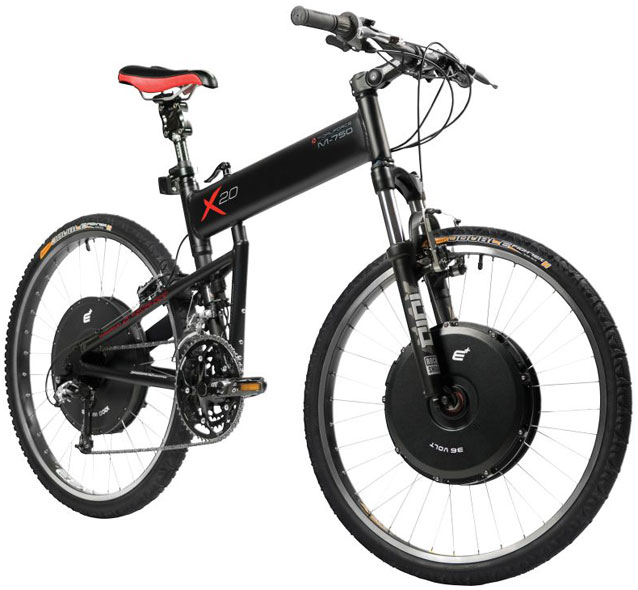
I had one of the first TidalForce cruiser electric bikes, and the engine was taken from a military product that was deployed with paratroopers, but I always regretted not buying the consumer version of the actual military bike.


E+ Tidalforce Bike M-750 X2.0 Limited Edition
(click image to enlarge)

Well e+, which took over for TidalForce with an improved product, brought out a numbered edition of the Military Fold Up electric bike, the M-750 2.0. Since my TidalForce was aging, I just bought it -- and it is wonderful.

It now has a 1,000 watt engine, it is military flat black, and it still folds in the middle (though I'm not going parachuting with it).

As you would expect, for an electric bike, it is light and fast, and it is such a kick to pass guys who are sweating like pigs peddling up steep hills with an easy stride and a smile (Xthe battery is concealed in the front hub and the engine in the rear hub) with few the wiser.

It is kind of like being bionic, and I have to admit it kind of takes me back to being a kid and I sometimes pretend, just a little, I'm Napoleon Solo (he was the man from U.N.C.L.E.) sneaking up on THRUSH. It isn't cheap -- but I so love my new bike, it had to be my product of the week.


Technology Access Foundation at Gnomedex - click to watch video